Web Security | Privilege Escalation | Red Teaming
Exploiting Web CMS Weaknesses and Privilege Escalation Misconfigurations in a Controlled Lab Environment

Debojit Singh | Red Team Practitioner & Open Source Founder, BlackPandaLabs
BlackPandaLabs is an independent open-source collective focused on cybersecurity education and research.
Disclaimer
This assessment was conducted within an authorized educational laboratory environment designed for cybersecurity training. Sensitive information including credentials, hashes, flags, challenge artifacts, payloads, and infrastructure indicators has been removed or generalized to preserve the integrity of the training platform and prevent direct solution disclosure.
Executive Summary
During this assessment, I evaluated a Linux-based target hosting a web application backed by a Content Management System (CMS). The objective was to identify weaknesses, gain initial access, enumerate the underlying operating system, and assess potential privilege escalation paths.
The engagement demonstrated how multiple individually manageable weaknesses can be chained together into a complete compromise. Publicly accessible information, authentication weaknesses, excessive application privileges, and local privilege management issues collectively enabled administrative access to the target system.
Attack Path Overview
Reconnaissance -> Information Discovery -> CMS Access -> Code Execution -> User Pivot -> Privilege Escalation
Environment Overview
The target consisted of a Linux server hosting a publicly accessible web application. Initial fingerprinting identified the presence of a WordPress installation along with several resources exposed through the web server.
The objective was not simply to gain access but to understand how weaknesses at different layers of the environment could be combined to achieve full system compromise.
Phase 1: Reconnaissance and Attack Surface Mapping
The assessment began with standard reconnaissance activities focused on understanding the exposed attack surface.
Web enumeration identified multiple publicly accessible resources that provided useful insight into the environment. While none of these resources represented a critical vulnerability on their own, they contributed valuable information that assisted later stages of the assessment.
Security Observation: Information disclosure remains one of the most underestimated security issues. Development artifacts, forgotten files, and improperly exposed resources often provide attackers with intelligence that significantly reduces the effort required for subsequent attacks.
Defensive Recommendations
- Audit publicly accessible files regularly.
- Remove unnecessary development artifacts.
- Restrict sensitive resources from anonymous access.
- Implement periodic web content reviews.
Phase 2: Authentication Assessment
Further enumeration revealed the administrative interface of the CMS platform.
The authentication controls protecting the portal were assessed as part of the engagement. Weaknesses in credential management ultimately allowed administrative access to the application.
Once administrative access was obtained, the potential impact of the compromise increased significantly because application management functionality became available.
Security Observation: Administrative portals represent high-value targets because they often provide direct access to application configuration, content management, and deployment functionality.
Defensive Recommendations
- Enforce Multi-Factor Authentication (MFA).
- Apply rate limiting to login endpoints.
- Implement strong password policies.
- Monitor abnormal authentication activity.
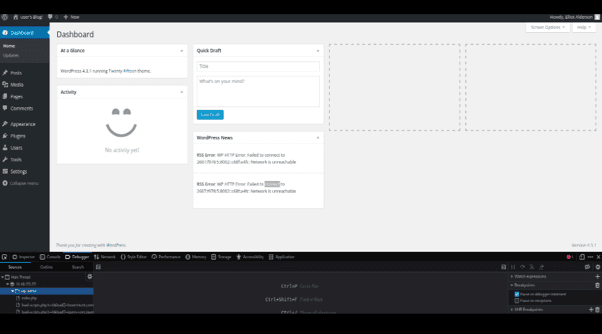
Phase 3: Application-Level Access
Following successful authentication, the assessment focused on understanding the capabilities available to an authenticated administrative user.
This phase demonstrated how excessive permissions within a web application can increase the impact of credential compromise. Administrative functionality exposed opportunities to interact with underlying application components and server-side resources.
Security Observation: Administrative access should not automatically provide unrestricted interaction with application files or underlying system resources.
Defensive Recommendations
- Disable unnecessary file-editing functionality.
- Implement file integrity monitoring.
- Restrict application write permissions.
- Separate deployment permissions from administrative permissions.
Phase 4: Local Enumeration and User Access Expansion
After establishing a foothold within the environment, local enumeration activities were conducted to identify users, services, permissions, and potential escalation paths.
During this phase, weaknesses related to credential management and local account security were identified. These weaknesses enabled movement from the initial context into a more capable user account.
The expanded access level provided additional visibility into the operating system and allowed further assessment of local privilege controls.
Security Observation: Weak credential storage practices remain one of the most common causes of privilege escalation and lateral movement.
Defensive Recommendations
- Use modern password hashing algorithms.
- Apply least-privilege principles.
- Rotate credentials regularly.
- Monitor privilege transitions.
Phase 5: Privilege Escalation Assessment
Further system analysis revealed a privilege management weakness involving an improperly configured privileged binary.
The configuration violated the principle of least privilege and created a path for elevation beyond the intended user context.
Successful exploitation resulted in administrative access to the target system.
Security Observation: Privilege escalation vulnerabilities frequently represent the final stage of a compromise chain and can completely bypass application-layer security controls.
Defensive Recommendations
- Audit privileged binaries regularly.
- Remove unnecessary elevated permissions.
- Maintain secure baseline configurations.
- Review legacy software deployments.
Key Findings
| Finding | Risk |
|---|---|
| Information Disclosure | Medium |
| Weak Authentication Controls | High |
| Excessive Administrative Functionality | High |
| Weak Credential Management | High |
| Privilege Escalation Misconfiguration | Critical |
Lessons Learned
This assessment reinforced several important security principles:
- Small weaknesses rarely exist in isolation.
- Information disclosure can directly enable credential attacks.
- Administrative access should not imply unrestricted system access.
- Credential management remains a foundational security control.
- Least-privilege principles are essential for limiting compromise impact.
Conclusion
This engagement demonstrated how multiple security weaknesses can be chained together to achieve complete system compromise within an authorized training environment.
While each issue individually may appear manageable, their combined impact created a viable attack path from external reconnaissance to full administrative access. The assessment highlights the importance of layered security controls, continuous monitoring, secure configuration management, and regular security reviews.
The exercise provided valuable insight into both offensive methodology and defensive remediation strategies, reinforcing the importance of security at every stage of the system lifecycle.